Almost three-quarters of England is now in drought as conditions worsen following a dry start to August.
The National Drought Group has warned all regions of the country are experiencing pressure on their water resources - with increasing impacts across agriculture, public supplies, navigation, and the environment.
The East Midlands, Lincolnshire & Northamptonshire, Kent & East Sussex, and Solent & the South Downs became the latest to move into drought status.
Along with the areas announced last week, most of the country (71.3%) is now experiencing a flash drought – which develops very quickly brought about by a combination of very low rainfall and higher temperatures. This takes the total to 45 million people in a drought area. Over 27 million people are now living under restrictions on water use.
Natural Resources Wales (NRW) has also confirmed that it is extending its drought declaration across the whole of Wales.
The North East and Yorkshire have moved to prolonged dry weather – the stage before drought – with nowhere now deemed in normal status.
The changes follow the driest July in 190 years and just 5% of expected rainfall this month to date. There are warnings of more dry weather and another heatwave on the way, with temperatures tipped to reach the mid-30s in some places.
Tony Grayling, Strategic Drought Lead at the Environment Agency and Chair of the National Drought Group, said:
Drought conditions are worsening and will continue to do so until we see significant and sustained rainfall.
We know the hot and dry weather is taking a real toll on farming and there will be long-lasting impacts on our environment.
We want everyone to stay safe and hydrated over the summer, but we need everyone’s help in using a little less water to make sure our current water reserves last. Every drop we can save is a drop more for your local farmers, local wildlife and local rivers.
Water Minister Emma Hardy has told water companies to do more to cut leaks, which increase in the hot weather as pipes move in dry soils.
Small steps to reduce water consumption – such as turning off taps when brushing teeth or fixing a leaking toilet – can also really add up to conserve dwindling supplies until the next period of sustained rainfall.
Ongoing work by National Drought Group members includes heightened incident response, additional monitoring, increased leakage reduction and more cross-sector and public communication.
The Government has also stepped up its drought response and is actively considering ways to give more support to the farming sector.
Water Minister Emma Hardy, who attended the National Drought Group, said: “We know how challenging this summer has been, especially for our hard-working farmers who are at the sharp end of climate change and an increasing number of floods and droughts.
“We are stepping up our support including working to make it easier for farmers to build more on-site irrigation reservoirs. We are also delivering long-term change in the water industry to reduce leaks and deliver nine new reservoirs and water transfer schemes to secure supplies.
“As we move through this period of drought, I expect water companies to take every available step to minimise leakage and support customers in using water wisely.
“I also want to thank people for following the restrictions, where in place, as they are an important tool to safeguard essential water supplies and protect the environment.”
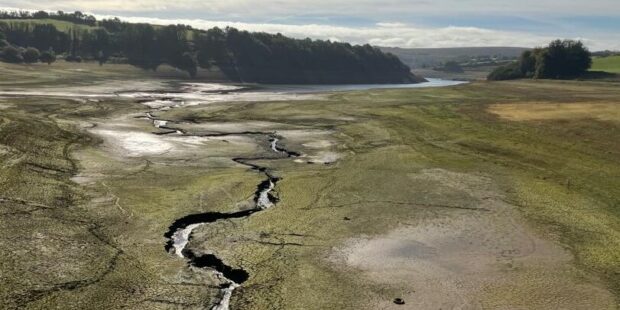
Rivers, reservoirs, and groundwaters continue to decline and water temperatures are also rising, leading to more fish rescues, while the continued hot and dry conditions are increasing the risk of wildfires.
The UK climate is changing and the current drought now means there have been three in the past five years – 2022, 2025 and now 2026
This year, there have been 34 days with temperatures that have reached 30C or above somewhere in England, including 13 consecutive days in July. Dry weather depletes our water, while the hot conditions mean we use more of it.
While temperatures cooled last week, and there were occasional showers, a high-pressure system means there is an increased risk of more hot and dry weather in August. Another heatwave has been predicted for this week, while the UKHSA currently has more heat alerts in place.
Head of Environment and Energy at the Met Office, Sarah Davies, said: “July 2026 was one of the most remarkable months in the UK’s climate record. England and Wales both recorded their driest and sunniest July on record, together with periods of exceptionally high temperatures. These conditions have significantly increased pressure on water resources in some parts of the country and contributed to the ongoing drought concerns.
“Looking ahead, forecasts for the remainder of August and into September suggest a good deal of dry weather is expected, mixed with some unsettled spells. While some areas may see useful rainfall at times, there is currently no strong signal for a sustained period of widespread rainfall, with below average rainfall more likely than above-average for the period as a whole.”
The Met Office will continue to work closely with partners through the National Drought Group, providing forecasts and climate intelligence to support planning and decision-making as conditions evolve.
Fran Barnes, Chief Executive of the Horticultural Trades Association (HTA), commented: “With almost three-quarters of England in “flash drought” and all of Wales now officially in drought, numerous water restrictions and Temporary Use Bans (TUBS) across the UK, and data showing that last month was officially the driest July on record, the pressure on our water resources couldn’t be clearer.
“The solution to the UK's water challenges lies not just in the amount of rainfall, but in how effectively we capture, store, and manage it. Today we reiterated the need for the UK to take action and implement a long-term water resilience strategy that addresses the realities of a changing climate.
“The current conditions are having a huge impact on our 1,400 members – garden retailers, growers, landscapers, designers, suppliers and manufacturers – despite our sector investing heavily in becoming more water efficient. Growers increasingly capture and recycle rainwater, retailers and landscapers promote drought-tolerant planting and more effective watering, including water butts and efficient irrigation systems suitable for gardeners, not just professional growers. We set out these needs again today at the National Drought Group meeting.
“Our climate may be changing, but our message remains clear: water resilience cannot be treated as a seasonal issue.
“Climate adaptation requires long-term investment in water storage, infrastructure and planning, alongside ongoing investment in the green infrastructure that makes our communities more resilient to extreme weather.
“Every summer, temperatures rise, rainfall disappears, water companies introduce Temporary Use Bans, and gardeners are urged to put away their hosepipes. Rather than gardeners, growers, and landscapers being the backstop and penalised first with water restrictions, there should be investment in the sector to provide solutions for our ‘new normal’ conditions.
“We must have a comprehensive water resilience strategy, and we need to see incentives or an easing of restrictions to allow more of our members to create water storage solutions fit for the climate volatility ahead.”