A nationwide FOI investigation by the Horticultural Trades Association (HTA) has found that more than half of councils in England are not fulfilling their legal obligation to collect non-black plastic plant pots from households for recycling — and most of those councils say they have no plans to start.
The findings come four months after the government’s Simpler Recycling reforms came into force, to make household recycling more consistent across England.
The HTA is warning that millions of gardeners are being left in a recycling postcode lottery, while horticultural businesses could face an estimated £750,000 a year in additional Extended Producer Responsibility (EPR) fees.
It says the findings highlight a disconnect between national recycling policy and local delivery, leaving businesses bearing additional costs despite investing in recyclable packaging.
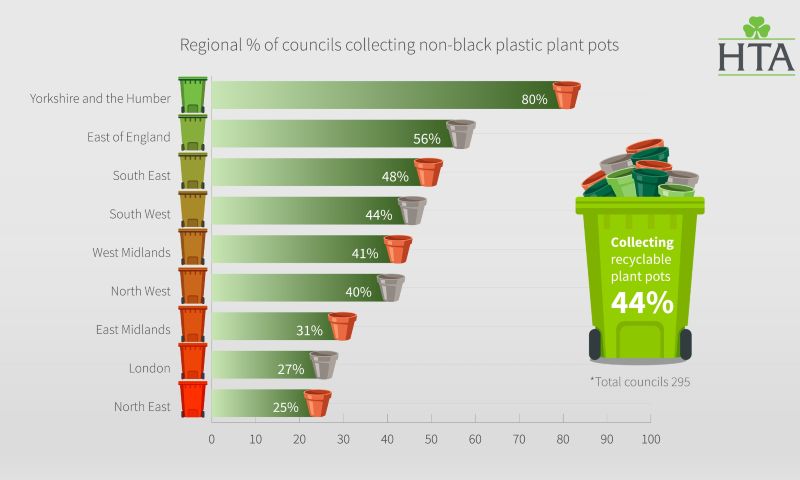
The FOI investigation, which contacted all 295 councils responsible for waste collections in England, found that only 44% currently collect non-black plastic plant pots through household recycling services.
A further 10% of councils say they plan to introduce collections, meaning that even if all those plans are delivered, only around half of councils would be collecting recyclable plant pots.
This is well below the 75% collection threshold used by the government to determine whether packaging is widely collected at kerbside under its Recyclability Assessment Methodology (RAM), which is used to determine how much businesses pay in EPR fees.
When looking at regional-level data on the percentage of collection, there is a stark divide. Yorkshire and the Humber is the only region where collection reaches the 75% threshold, with 80% of councils collecting recyclable plant pots. At the other end of the scale, collection is just 25% in the North East and 27% in London.
The FOI responses show significant variation in why councils are not collecting the material. Reasons include a lack of recycling infrastructure, limitations at Materials Recovery Facilities, existing waste contracts, reliance on Waste Disposal Authorities and uncertainty over the requirements or practical implementation of Simpler Recycling.
In some areas, councils are waiting for new infrastructure before collections can begin, meaning householders could remain unable to recycle recyclable plant pots for years after the reforms came into force.
The environmental horticulture sector began moving away from traditional black plastic plant pots in 2018, introducing the recyclable ‘taupe pot’ as an alternative.
Non-black polypropylene pots are designed to be detected by the near-infrared sorting technology used in modern recycling facilities, enabling their separation and recycling.
The sector has invested in this transition to improve recyclability and support a more circular approach to plant production and retail.
The HTA estimates that around 300 million plant pots reach UK consumers and households each year. At that scale, inconsistent collection is not a minor waste-management issue: it risks losing recyclable material from the circular economy at the point when households and businesses are being asked to do more to cut waste, reduce emissions, and respond to the climate challenge.
Under EPR, the Government is using the RAM to differentiate fees according to the recyclability of packaging. For 2026/27, the published illustrative figures put the plastic Green fee – those deemed widely recyclable - at £415 per tonne, compared with £455 per tonne for Amber-rated plastic packaging, which, whilst recyclable, is not collected by enough local authorities.
The HTA has analysed the FOI findings alongside assumptions about the volume, type, and weight of plant pots reaching households, estimating that the failure to achieve widespread collection could result in approximately £750,000 per year in additional EPR costs for the horticultural industry.
Samantha Smith, Policy and Public Affairs Manager at the Horticultural Trades Association, said: “The whole point of Simpler Recycling was to make recycling easier and more consistent for households. Our investigation shows that, when it comes to recyclable plant pots, that simply isn’t happening.
“Our sector changed the way it makes and supplies pots because we wanted to improve recyclability. The taupe pot was introduced in 2018 as a recyclable alternative to traditional black plastic, and our member businesses have invested significantly in that transition.
“Eight years on, gardeners can buy a recyclable plant pot but have no guarantee that their local council will collect it.
“That isn’t a failure of consumers. It is a failure of the system around them.
“And despite making the transition, it will be businesses paying the price. We estimate that the lack of widespread collection could mean around three-quarters of a million pounds a year in additional EPR costs for horticulture, simply because local authorities failed to comply with the legislation introduced to tackle this very issue.
“For a sector made up of more than 90% SMEs, this is another cost at a time when businesses are already facing significant pressures from rising costs and major regulatory change, particularly around staffing.
“More fundamentally, this points to a wider challenge with EPR implementation. Our members are already navigating a range of complexities related to packaging reform, reporting requirements, take-back schemes, and collection arrangements. They need certainty, proportionate regulation and a system that works consistently from end to end.
“Our members have invested in recyclable packaging, supporting plants that are ultimately good for the planet, and want to play their part in creating a more circular economy. But when national policy, local collection systems and recycling infrastructure are not aligned, businesses end up paying the cost without being able to deliver the environmental outcomes the reforms were designed to achieve.
“Government has set a national direction on recycling. It now needs to make sure the infrastructure, contracts and local delivery are aligned with that ambition.
“If we want people to recycle more, they need a system that works consistently — not one that changes at the end of their postcode.”
The HTA is calling on the government, local authorities, Waste Disposal Authorities, waste contractors and recycling operators to work together to address the gaps identified by the FOI investigation and ensure that eligible recyclable plant pots can be consistently collected and processed. It also wants to see clear communication to residents that they can now recycle their non-black plastic plant pots to prevent them unnecessarily ending up in landfill.
Environmental horticulture contributes £38 billion to the UK economy annually, supports 722,000 jobs, and comprises more than 90% small and medium-sized enterprises.
The HTA says businesses that have invested in recyclable packaging should not face additional costs because the collection system needed to support that investment has not been delivered consistently.