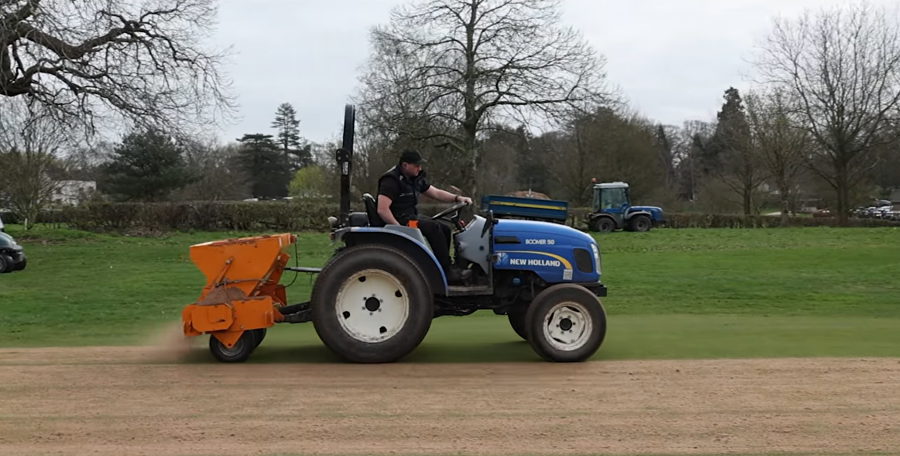
New Rescue II from Syngenta now gives turf managers the chance to selectively remove invasive coarse grasses from fine turf surfaces, while leaving desirable grass species unaffected.
The eagerly awaited launch of Rescue II utilises the same innovative herbicide technology as original Rescue, but in a new formulation designed to maximise efficacy on target problematic coarse grasses, while enhancing safety on selected species.
The new approval for Rescue II covers all managed areas of the golf course and fine turf sports surfaces, such as bowling greens and croquet lawns.
Invasive coarse grasses severely affect the smoothness and consistency of fine turf playing surfaces, as well as visual appearance, warns Syngenta Technical Manager, Pete May. “Thick clumpy ryegrass and Yorkshire fog also makes rough areas unplayable and slows up golf rounds, as well as choking out wildflowers and natural fauna.
“The chance to selectively remove the unwanted coarse grasses quickly and cost effectively rejuvenates sustainable fine fescue surfaces and allows attractive wispy rough to flourish.”
Coarse grasses can spread from surrounding roughs and out of play areas, or historic agricultural sources, he reports. Turf cover loss on fairways through drought conditions in recent seasons has also enabled more coarse grasses to encroach into playing areas.
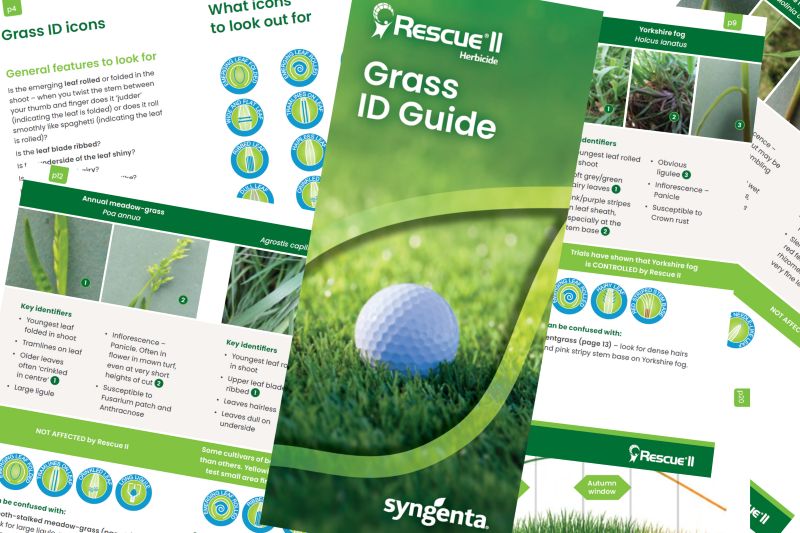
“It is crucial to accurately identify your existing sward composition before starting Rescue II treatment programme, to pre-assess effects and how much will be removed,” says Pete. “A range of coarse grass species will be taken out, while fescue grasses and Poa annua will be unaffected. Some bentgrass species are seen to be more affected than others, so if they form a high proportion of the sward, it’s advisable to do some test treatments first.”
Rescue II can be used as a key part of a sward rejuvenation programme, including overseeding with fescue grasses prior to and bent and fescue post application to rapidly restore surface quality after target coarse grasses have been removed. In most cases is no interruption to play during the treatment process.
Application at a rate of 0.82 l/ha between March and the end of August. Applications should be made when target grasses are actively growing to maximise uptake and translocation to the roots, while a period of prolonged growth also helps turf surface restoration as coarse grasses die back.
The Rescue II programme is supported by a package of information and advice, including a comprehensive grass identification guide, technical use guide and Turf Advisor dashboard to support application timing. A clubhouse poster is available to inform players what they will see and an online Q&A answers questions for club managers and players on the Syngenta Turf website.
New Vertenzo meets challenge of climate shift for turf disease
An entirely new turf fungicide from Syngenta has been designed to better help turf mangers cope with the challenge of increased turf disease with climate shift. Vertenzo contains an exciting new active ingredient for turf, proven to give excellent results against microdochium patch and dollar spot.
Warming temperatures now result in longer periods of more intense pressure for both summer and autumn/winter diseases, warns Syngenta Technical Manager, Pete May. That threatens to overwhelm cultural practices and existing disease control programmes.
The product's powerful new active ingredient, prothioconzole, represents a significant technology advance in turf disease management. Its broad-spectrum control, combined with both preventative and early curative properties, provides a versatile fungicide that can be used confidently throughout the annual disease control programme.
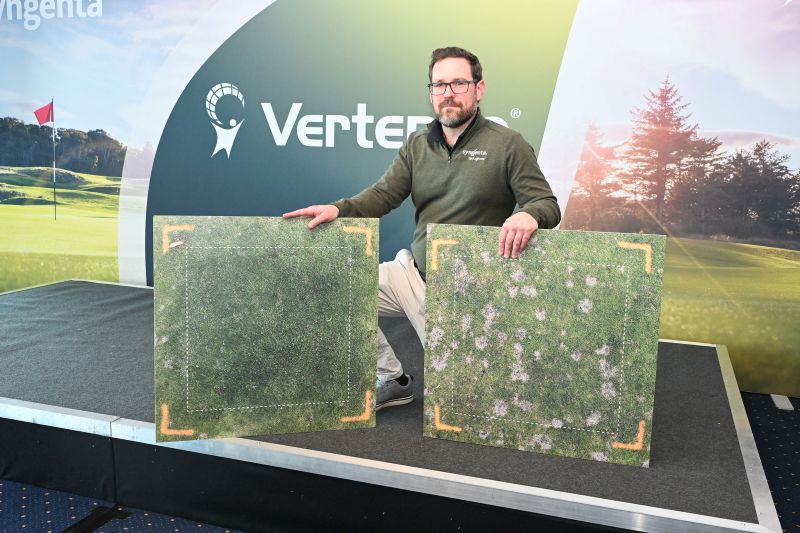
“Vertenzo gives a valuable new option to extend all important protection when the risk of damaging disease infection is rising. With the active growing season now extended later into autumn and early winter, there’s greater need for systemic products that can protect turf for longer,” he advises.
The approval for Vertenzo also includes fairway application on golf courses, giving the chance to control the increasingly widespread issues of dollar spot and targeting some other diseases that can weaken turf cover andt make it more susceptible to loss.
“Furthermore, the rapid rainfastness of Vertenzo ensures protection will stay in place even if it rains 30 minutes after application,” reports Pete. “That makes it really versatile for the highest risk periods of prolonged leaf wetness and high humidity.” The systematic movement throughout the plant also means it adapts to changing conditions and provides protection of any new growth, combined with exceptional turf safety.
Vertenzo is approved for use on all areas of managed amenity turf, including golf course greens, tees and fairways, as well as other sport turf surfaces in stadiums and other amenity situations.
“Two applications of Vertenzo are permitted per year, which will prove especially useful to tackle extended dollar spot infections that are now frequently seen to occur from May to October, as well as the longer microdochium infection period in the autumn and winter,” he adds.
Climate shift records indicate temperatures have consistently risen by over 1.5⁰C in peak summer periods that has seriously increased the severity of dollar spot attacks, while a lack of cold winter temperatures below 2⁰C to stop microdochium development has seen repeated outbreaks occurring over the winter months.
“Effective cultural practices are an essential part of the Integrated Turf Management strategy to reduce disease risks, but increasingly the pressure is just too high. A well-planned and timed fungicide programme is crucial to prevent infection and maintain surface quality,” advocates Pete.
In latest independent trials at STRI in Yorkshire, cultural practices alone reduced dollar spot infection levels by around 30% compared to untreated, but still left 9% of the surface affected. The addition of Vertenzo in a fungicide programme alongside ITM helped maintain infection at under 2% of the surface affected right through the trial monitoring.
“As well as tackling summer diseases, we are also seeing Vertenzo as being extremely effective for autumn applications, where it can target both late dollar spot and early microdochium pressures that can frequently be occurring at the same time,” he advises. “That’s especially valuable in giving turf managers and agronomists options to extend and alternate fungicide choice through this key period.”
In trials throughout the UK and across Europe Vertenzo has consistently matched or exceeded the performance of the renowned and industry-favourite, Instrata Elite. Used in sequence in the programme, it gives a step change advance in the overall disease control strategy.
The application rate is 0.6 L/ha with the easy-to-use liquid formulation supplied in 720ml packs – sufficient to treat a typical 18-hole golf course greens and surrounds complex of 1.2 hectares.