A football pitch is rarely just a football pitch.
Across the world, the Cruyff Foundation is proving exactly that, using high-quality synthetic turf to create safe, durable spaces that support health, inclusion, and opportunity for children and young people in low-income areas.
The Foundation, which operates in 22 countries since its establishment in 1997, has tasked itself with providing opportunities for children, especially those with disabilities, to engage in sports and play.
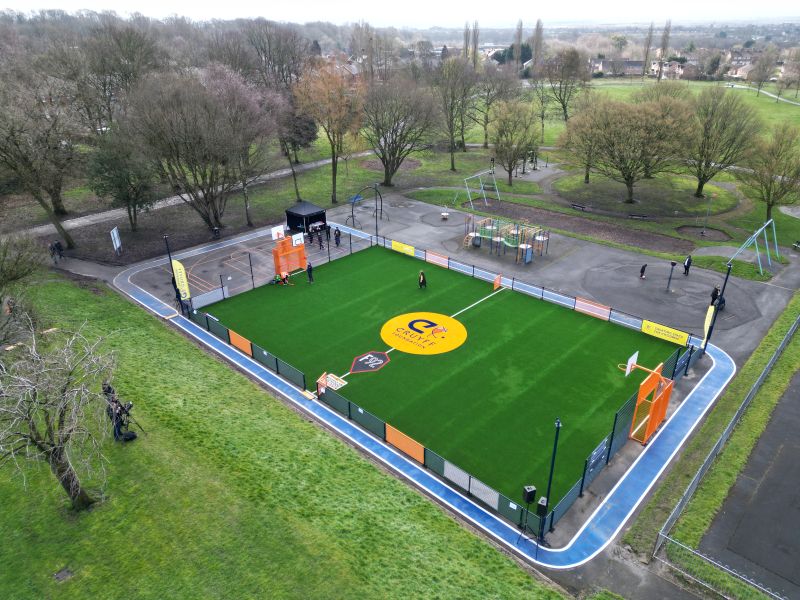
Rooted in the legacy of Johan Cruyff, Cruyff Courts are small football fields integrated into neighbourhoods, often in collaboration with local or municipal governments, to create spaces for children to grow, make friends, and improve their physical and mental health.
Synthetic turf sits at the heart of the model. Close to 95% of the 350 Cruyff Courts built since 2004 use artificial surfaces, chosen for their quality, year-round playability, and durability. Because the courts become a source of local pride, they tend to attract care rather than vandalism, helping them serve their communities for longer. That sense of ownership is central to how the Foundation works, with local partners such as professional football clubs and municipalities maintaining the courts and running programmes for at least ten years.
The surfaces also provide a platform for sustainability innovation. Across the network, the Foundation has introduced solar-powered lighting and advanced water management systems, including a project in Orange Farm, near Johannesburg, South Africa where rainwater is collected beneath the pitch and filtered to provide clean drinking water. The ‘Catch-Store-Reuse’ system captures rainwater, stores it in its subbase, and purifies it in a GreenSource container next to the field.
Crucially, every Cruyff Court is more than a surface. Each one is supported by at least one trained Cruyff Coach delivering structured programmes built around youth leadership, mental health and gender equality, including dedicated safe spaces for girls to develop through sport. This focus on programmes is what turns a pitch into a genuine community asset.
The Foundation has been careful to grow in a way that protects that quality. Rather than expanding into as many countries as possible, it concentrates on enhancing its presence in countries such as the Netherlands, Spain, the UK, South Africa, Malaysia, and China, where it is already established. The UK has seen particularly rapid growth, rising from 30 to 50 courts in the past year, with a similar trajectory planned in China.
Local identity is reinforced by naming courts after community figures and football legends. The Dennis Bergkamp Cruyff Court in Islington was the first to open in the UK back in 2008, and is now a hub for Arsenal in the Community. It remains a powerful example of how a single pitch can bring together a neighbourhood and create opportunities that reach well beyond sport.
Niels Meijer, CEO of the Cruyff Foundation, said: "Every Cruyff Court starts with a simple idea, that everyone deserves a safe place to play. Synthetic turf allows us to deliver that in almost any environment, giving communities a high-quality, durable surface they can use all year round and genuinely call their own.
"But the surface is only the beginning. By pairing each court with trained coaches and structured programmes, we help young people build confidence, leadership, and a sense of belonging. That combination is what creates lasting change in the communities we work with."
Stefan Diderich, Director General at ESTC, said: "The Cruyff Foundation shows just how much synthetic turf can offer beyond the game itself. A well-built, well-maintained court gives a community a safe, lasting space to come together, whatever the weather and for many years to come, and that is something this industry should be proud to support."