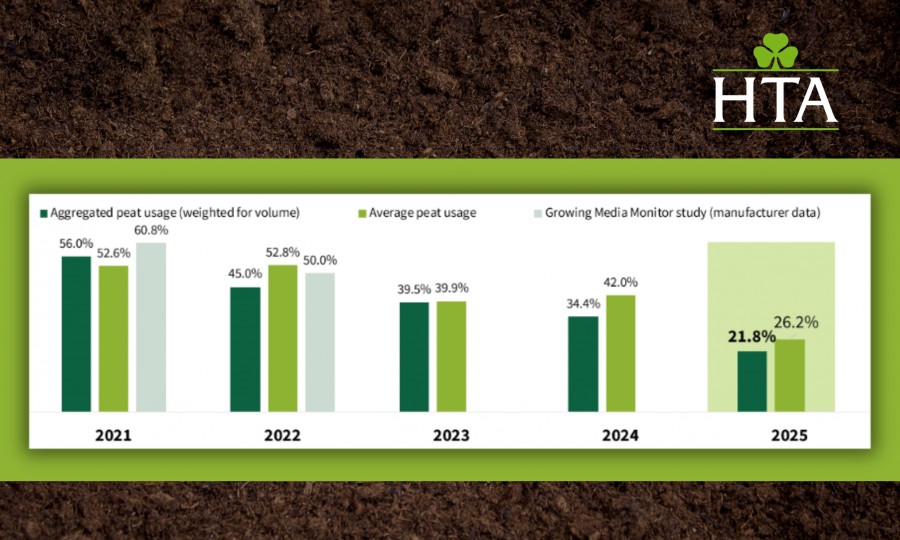
The latest figures from the Horticultural Trades Association (HTA) show that UK growers and plant producers have continued to make substantial progress in reducing peat use, with peat accounting for just 21.8% of growing media in 2025, down from 34.4% in 2024 and 39.5% in 2023.
This equates to professional peat levels falling by more than 60% since 2021, when it stood at 56%.
The HTA Growers Growing Media Usage Survey 2026 also found that one-third (33%) of growers are already peat-free. Businesses across the sector have made significant investments and driven innovation and technical adaptation in recent years, as reflected in the results of this survey. The headline figures demonstrate continued progress despite ongoing uncertainty around future policy and legislative timescales.
The findings reflect the results of collaboration through the supply chain, and the innovation, investment and intensive of growers and growing media manufacturers. However, while progress has been substantial, the survey results also indicate that the industry is now entering the most challenging phase of the transition. Whilst one-third of growers are already peat-free, a significant proportion remain uncertain about when they will be able to achieve 100% peat-free production, with around a quarter unable to identify a timeframe.
The findings show that the biggest challenges for growers moving away from peat are nutrient and fertiliser management, costs and profitability, consistency of peat-free growing media and irrigation management. Growers reported that fully peat-free growing media could cost around 10% more overall, with individual businesses reporting cost increases of between 5% and 15%, before accounting for expenditure on trials, staff training, production changes and potential crop losses.
Water management is becoming an increasingly significant issue for many businesses, particularly as growers face hotter summers, prolonged dry periods and growing pressure on water resources. Peat-free growing media often require different irrigation approaches and greater monitoring to maintain optimum growing conditions, meaning the transition is frequently about changing entire production systems rather than simply replacing one growing medium with another.
The findings suggest that the industry is currently facing the most technically complex stages of the transition away from peat. This will increase the need for knowledge transfer support and manageable time frames for growers to successfully navigate these significant challenges. Removing the final proportion of peat use is likely to prove technically complex and will continue to carry costs for growers. In addition, analysis of crop wastage data found that while average crop wastage across production remained around 9%, variability in crop wastage increased as peat use reduced.
David Denny, Director of Research & Knowledge Transfer at the Horticultural Trades Association (HTA), said: "These figures show that environmental horticulture continues to deliver real progress in transitioning towards peat alternatives. Levels of professional peat use have fallen year-on-year since 2021, and around one third of growers are now peat-free. That achievement is a result of the hard work, investment, research, innovation and knowledge sharing between growers and growing media manufacturers. What makes the achievement all the more remarkable is that it’s been delivered by the industry in spite of rising costs of doing business, and ongoing uncertainty over legislation relating to the sale of peat.
"The data also reinforces an important point: peat-free growing is not simply a case of swapping one material for another. There is no single, like-for-like alternative that works across the thousands of plant species grown commercially in the UK. In many cases, growers are redesigning irrigation systems, adapting nutrient programmes and developing entirely new production techniques to maintain plant quality and consistency. Water management is an increasingly important part of that challenge. Growers are having to learn how different growing media behave, and to invest in new approaches to irrigation that deliver both crop quality and resource efficiency.
“Our member businesses need certainty, but they also need confidence that the remaining technical, commercial and supply chain challenges have been properly understood and addressed. Continued research, collaboration and knowledge-sharing, investment support and a favourable regulatory environment will be critical to achieving our shared environmental ambitions while expanding a resilient, productive and competitive UK growing sector."
The HTA continues to support growers through technical guidance, research, workshops and knowledge-sharing activities, while calling for a supported transition to peat-free growing that is underpinned by clear policy direction, ongoing research and practical support for businesses managing the final stages of peat reduction.